- Began
- 1861, Boston — William Mumler
- Famous trial
- Mumler, New York, 1869 (acquitted)
- Exposure
- William Hope tested by Harry Price, 1922
- Method
- Double exposure, prepared plates
Historical source
William Mumler and the first 'extras'
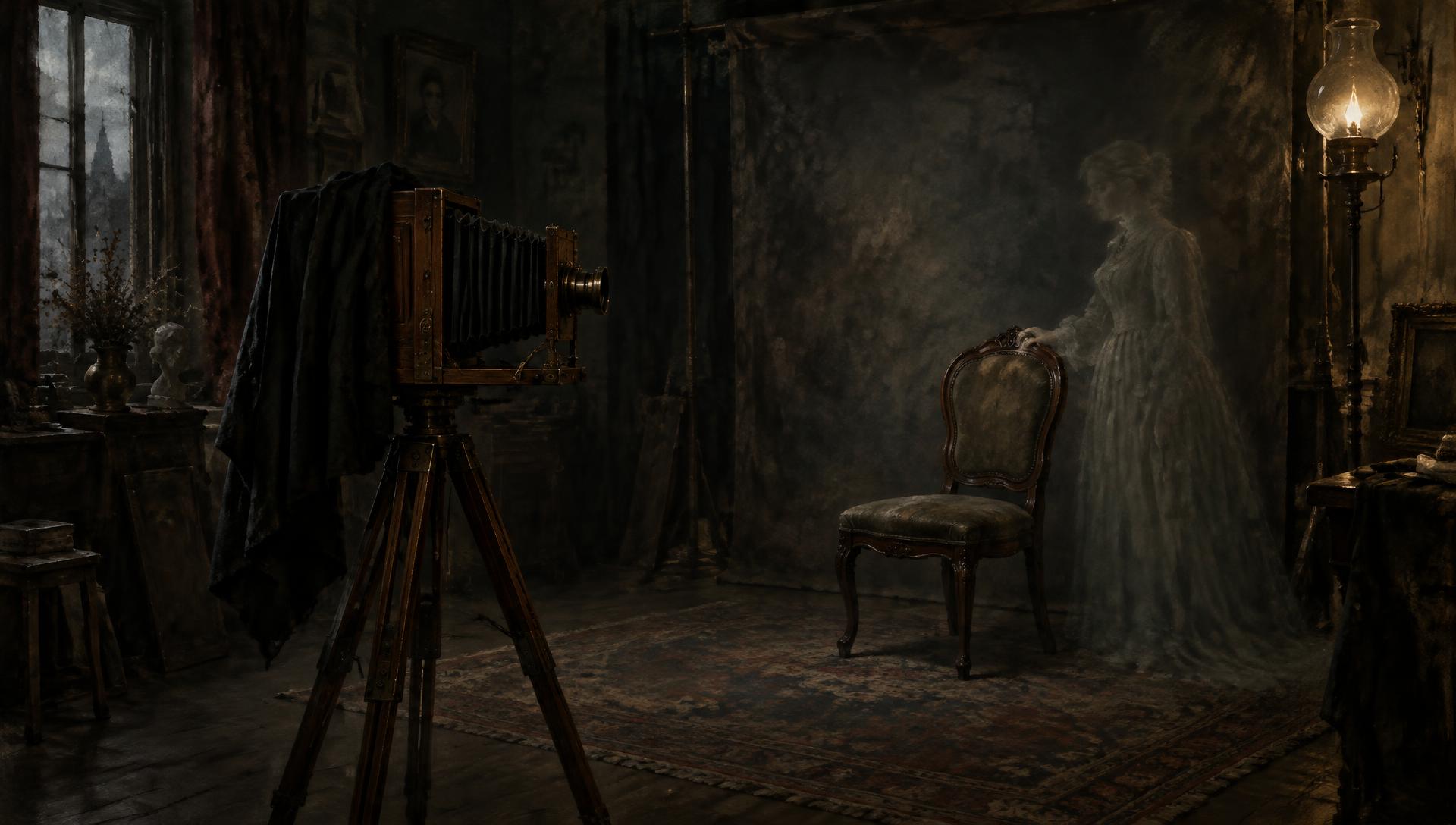
In 1861 a Boston engraver named William H. Mumler produced a self-portrait showing a faint figure beside him, which he said was the spirit of a dead cousin. Grieving families, many of them bereaved by the American Civil War, paid to sit for him in the hope of seeing a lost relative appear in the print.
In 1869 Mumler was tried in New York for fraud. Witnesses, including the showman P. T. Barnum, argued the effect could easily be faked, but he was acquitted for lack of proof of how it was done. His most famous image, made around 1872, shows Mary Todd Lincoln with a figure resembling her murdered husband.
The Crewe Circle and Harry Price
In England, William Hope and the 'Crewe Circle' produced spirit photographs for two decades and were championed by Arthur Conan Doyle. In 1922 the investigator Harry Price secretly marked photographic plates before a sitting with Hope; the resulting 'spirit' image appeared on a plate that did not bear Price's mark, strongly indicating substitution.
Grief, memory and the photograph
Spirit photography should not be confused with Victorian post-mortem photography, in which the recently dead were genuinely photographed, often posed as if asleep, as a final keepsake. Both practices grew from the same longing: to keep the dead visible in a century of high mortality.
Today the images are studied as social history. They show how new technology was quickly bent to the oldest human wish — one more glimpse of someone who has gone.
Further reading
- — The Case for Spirit Photography (Arthur Conan Doyle, 1922)
- — The Perfect Medium: Photography and the Occult (Metropolitan Museum of Art, 2005)
Historical summaries are provided for education. Reported experiences are not automatically presented as verified paranormal events.
More on remembrance
Near-Death Experiences →