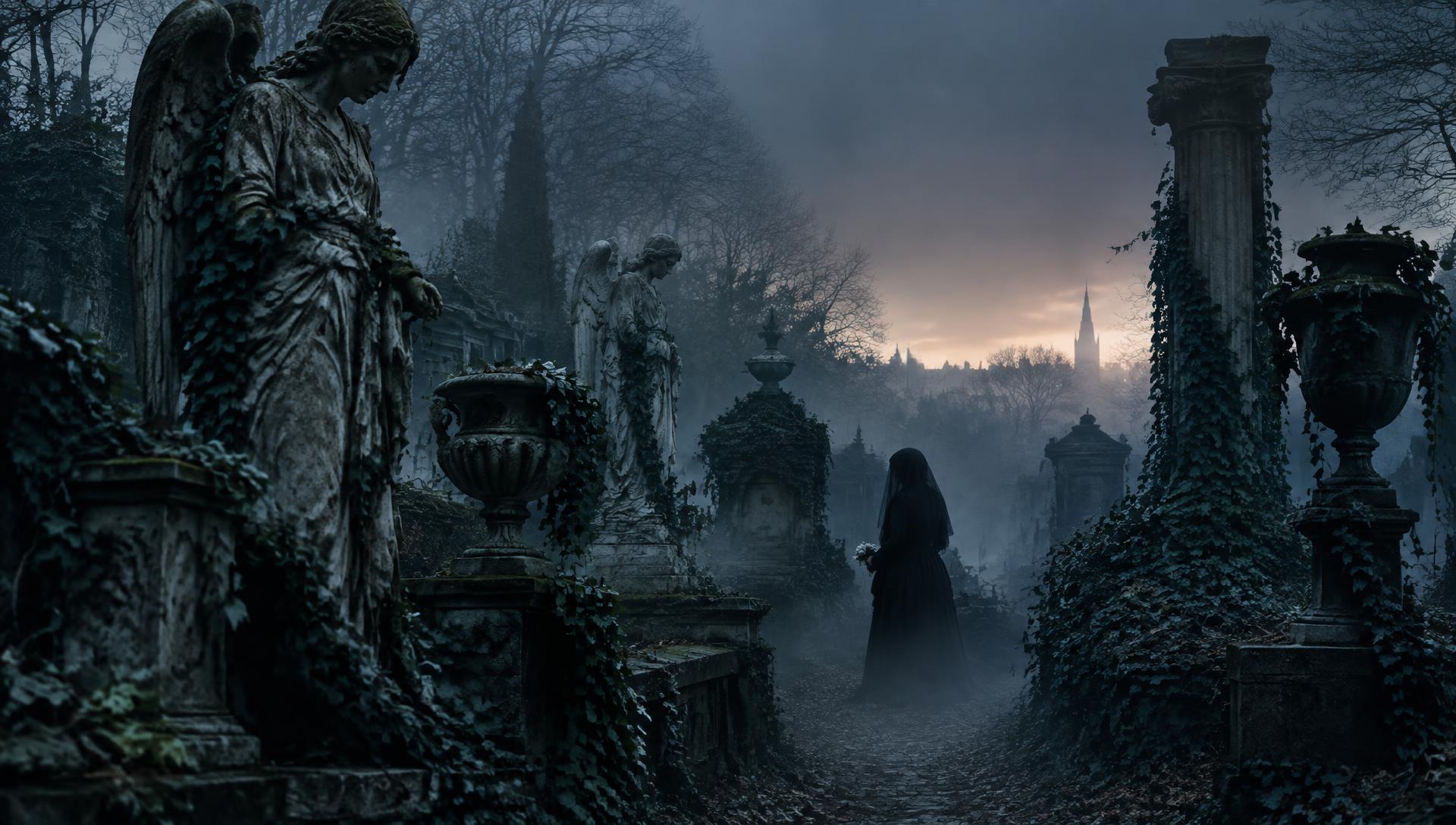
- Victorian mourning
- Up to two years for a widow
- London's 'Magnificent Seven'
- Garden cemeteries, 1833–1841
- Día de Muertos
- 1–2 November, Mexico
- Qingming
- Spring tomb-sweeping, China
Historical source
The Victorian cult of mourning
After Prince Albert died in 1861, Queen Victoria wore black for the rest of her life, and her grief shaped a nation's customs. Widows were expected to observe deep mourning for a year and a day, then gradually lighter stages. Black crape, mourning stationery with black borders, and jewellery carved from Whitby jet or woven from the hair of the deceased became part of everyday life.
Overcrowded churchyards led Parliament to permit large garden cemeteries. London's 'Magnificent Seven', including Kensal Green (1833) and Highgate (1839), were designed as landscapes for walking and remembering, filled with angels, urns and broken columns symbolising lives cut short.
Watching over the dead
Older British and Irish customs included the wake, in which the body was watched through the night, mirrors covered and clocks stopped at the hour of death. In early nineteenth-century Scotland, iron 'mortsafes' were placed over fresh graves to protect the dead from body snatchers supplying anatomy schools.
Festivals of return
In Mexico, Día de Muertos (1–2 November) welcomes the dead home with ofrendas of marigolds, photographs, food and candles. In China, the Qingming festival sees families sweep and tend ancestral graves. All Souls' Day in the Christian calendar, Obon in Japan and many other observances share the same conviction: the dead are not forgotten, and in some sense they return.
Further reading
- — Death in the Victorian Family (Pat Jalland, 1996)
- — Highgate Cemetery Trust
Historical summaries are provided for education. Reported experiences are not automatically presented as verified paranormal events.
More on remembrance
Borley Rectory →