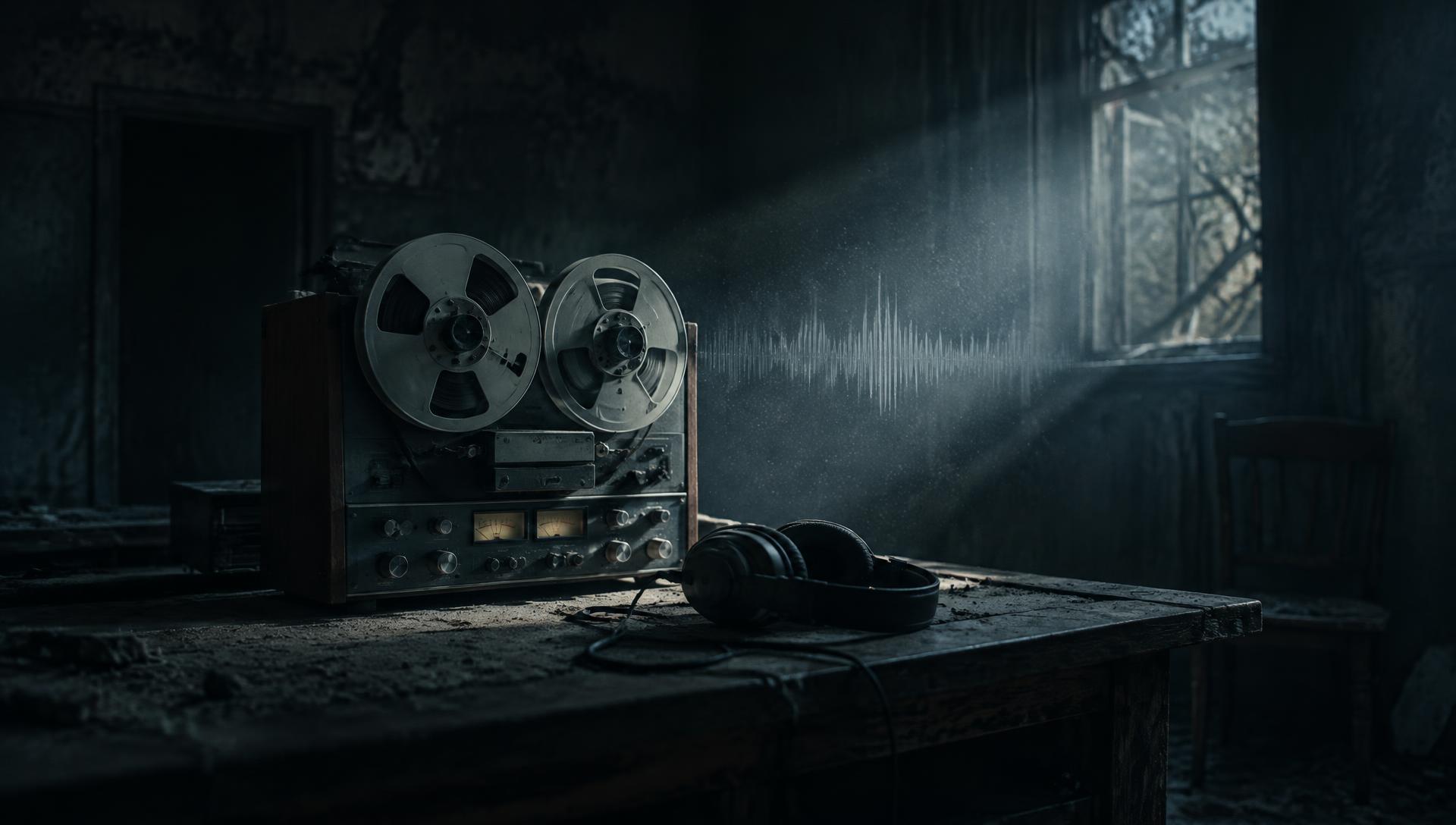
- Early recording
- Friedrich Jürgenson, 1959
- Key book
- Breakthrough (Konstantīns Raudive, English 1971)
- Association
- AAEVP, founded 1982 by Sarah Estep
- Main alternative
- Auditory pareidolia & radio interference
Research
Birdsong and a voice
In 1959 the Swedish painter and film-maker Friedrich Jürgenson was recording birdsong when he heard what he believed were human voices on the tape, including one he took to be his late mother. He devoted the rest of his life to recording such voices.
The Latvian psychologist Konstantīns Raudive extended the work, gathering tens of thousands of recordings. His book, published in English as Breakthrough in 1971, made EVP known worldwide.
From reel-to-reel to spirit boxes
In 1982 Sarah Estep founded the American Association of Electronic Voice Phenomena. Later generations of investigators adopted digital recorders and 'spirit boxes' that sweep rapidly through radio frequencies, producing fragments of speech for listeners to interpret.
How we handle recordings
Radio broadcasts, baby monitors, mobile phones and equipment noise can all produce voice-like sounds. Our brains are tuned to detect speech, so suggestion — being told what a recording 'says' — powerfully shapes what we hear. We log time, location, equipment and conditions for every recording and ask listeners to transcribe independently before any interpretation is shared.
Further reading
- — Breakthrough (Konstantīns Raudive, 1971)
- — Research on auditory pareidolia and suggestion
Historical summaries are provided for education. Reported experiences are not automatically presented as verified paranormal events.
More on spirit communication
Discoverie of Witchcraft →