- Associated practice
- Spiritualism, mid-19th century onwards
- Related device
- Ouija board, patented 1890
- Psychological account
- The ideomotor effect (W. B. Carpenter, 1852)
- Status
- Not verified as spirit communication
Historical source
The hand that moves alone
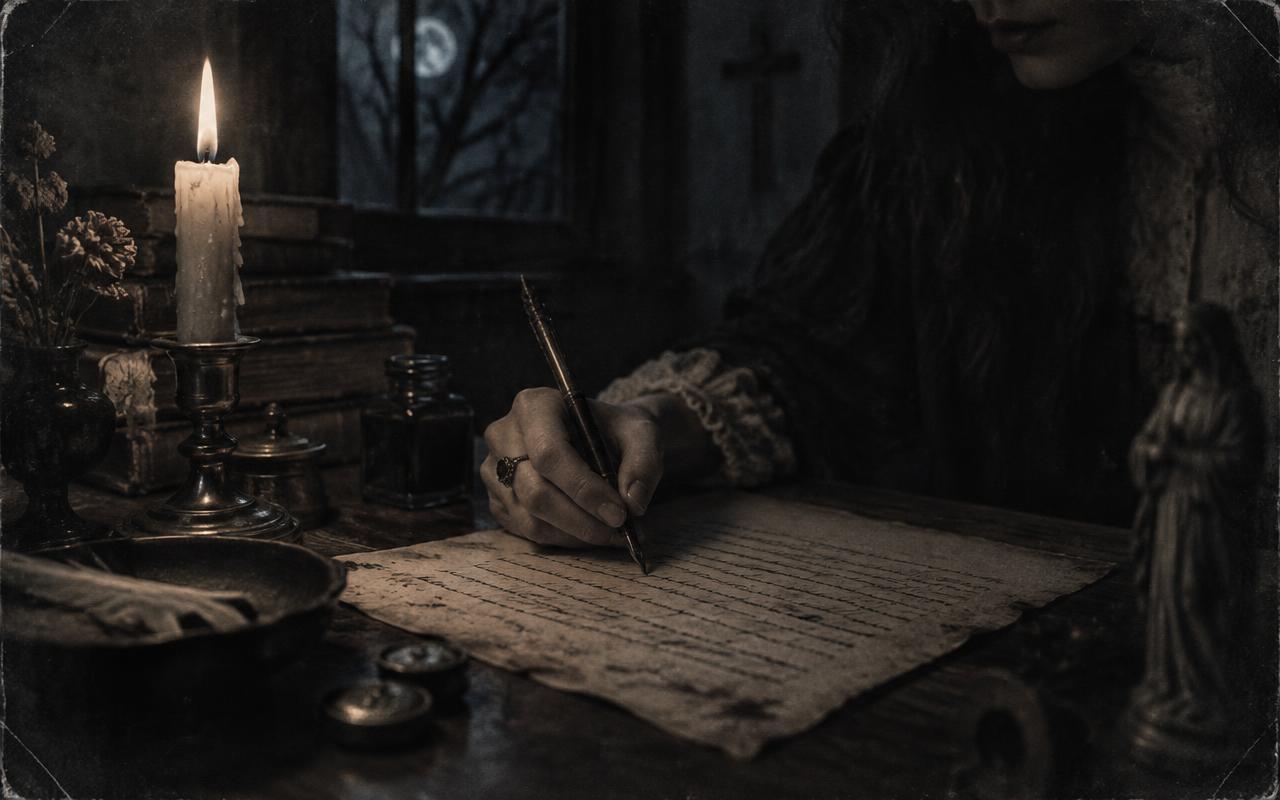
Practitioners would sit with paper and pencil, often after dark or in a quiet room, emptying the mind and letting the hand write. Messages arrived in scripts claimed to be those of the dead, of distant spirits, or of entities with names of their own. Some communicators 'spoke' through the same hand for years, developing distinct styles and life stories.
The practice spread through spiritualism's networks and produced celebrated cases, most famously the 'Patience Worth' scripts produced by Pearl Curran in Missouri from 1913 — hundreds of thousands of words of period-style verse and prose, delivered through a ouija board and a pencil, and examined by psychologists and sceptics without settling the argument to anyone's full satisfaction.
The ideomotor explanation
In 1852 the physiologist William Benjamin Carpenter named the effect now considered the core explanation: ideomotor movement. Tiny, unconscious muscular actions, primed by expectation, are enough to move a hand or a planchette without the mover ever feeling that they are doing it. The same effect explains the movements of dowsing rods and ouija boards.
Experiments have shown the effect reliably: when subjects are told which way to 'expect' a movement, the writing follows the expectation; when genuinely unaware, people still produce movement while sincerely denying causing it. This does not make practitioners dishonest — it makes the hand an unreliable narrator.
Reading the scripts today
The scripts survive as curious cultural documents, studied by historians of spiritualism and of literature. Some are gibberish; some are moving; a few are long enough and skilled enough to have provoked genuine debates about where the words came from.
We present automatic writing as a practice associated with spiritualism, not as verified communication from spirits. The candlelit desk on this page is an illustration of the practice, not a record of an investigation.
Further reading
- — Research on the ideomotor effect
- — The case of Patience Worth (1913–1937)
Historical summaries are provided for education. Reported experiences are not automatically presented as verified paranormal events.
More on spirit communication
Society for Psychical Research →