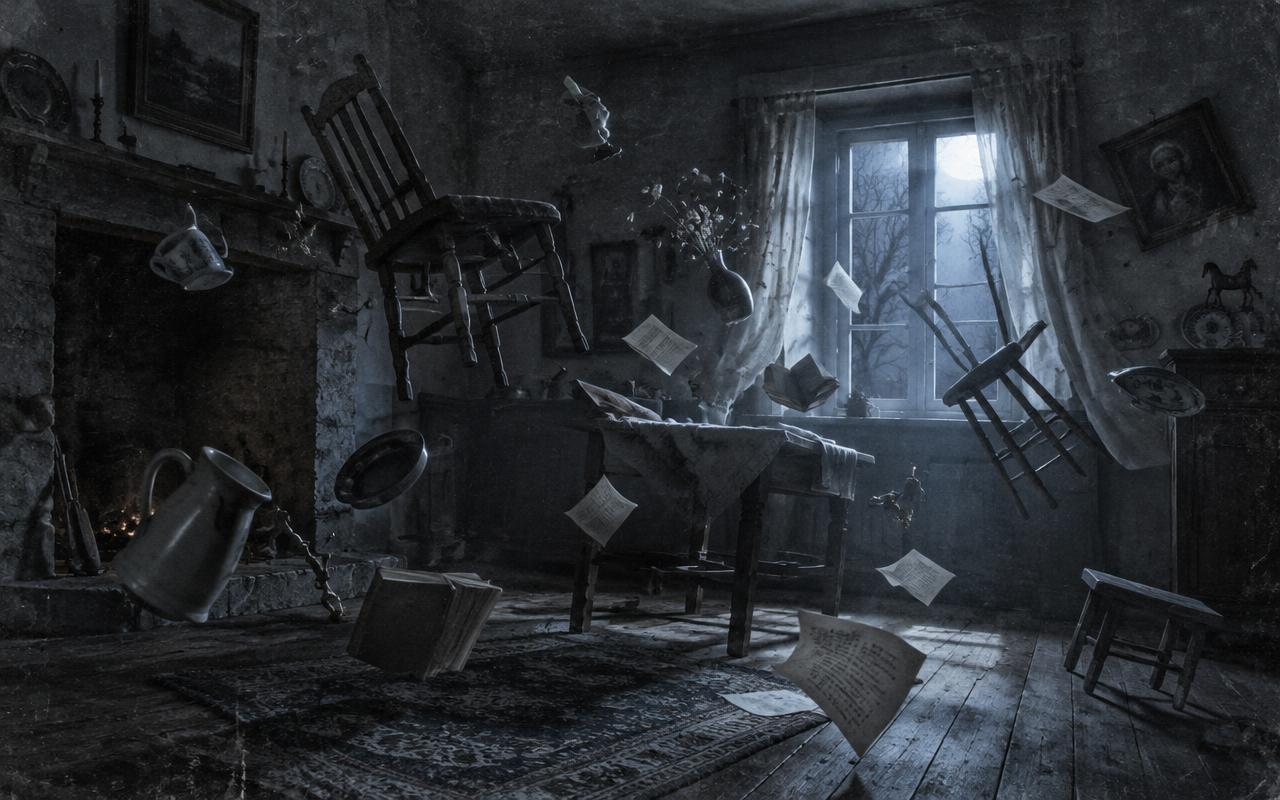
- Word origin
- German: poltern (to make noise) + Geist (spirit)
- Typical reports
- Knocks, raps, thrown or moved objects
- Famous case
- The Enfield Poltergeist (1977–79)
- Alternatives
- Ordinary causes, trickery, psychology
Folklore
The noisy spirit
Early English accounts, such as the reported drumming of the 'Drummer of Tedworth' in 1661–62, set the pattern that has repeated ever since: knocking or drumming, objects hurled or vanished, small fires, and phenomena that cluster around one person — very often a child on the edge of adolescence.
Some cases became national sensations, drawing investigators, journalists and crowds. Nearly all were short-lived: weeks or months, then the phenomena stopped, which is itself a clue — dramatic unexplained events rarely end on schedule.
What investigation has found
Where poltergeist cases have been examined closely, a familiar set of ordinary causes turns up again and again: hidden accomplices, thrown objects caught on camera, structural noise, static electricity, and the effect of suggestion on frightened households. Investigators have also caught celebrated cases being faked — including, in part, Enfield itself.
Psychologists have proposed that the phenomena may function as a pressure valve: a household under stress, an adolescent under strain, and an outlet of events no single person seems responsible for. This remains a hypothesis rather than an established mechanism, but it fits the recurring shape of the reports better than any spirit theory has so far.
How we handle poltergeist reports
A report of moving objects is investigated like any other: secure the room, account for every person and every object, keep cameras and timestamps, and test the building — floors, plumbing, vermin, draughts — before treating anything as unexplained.
Treat the family with care. Whatever is causing the events, the people living through them are frightened, and that fear is real. Read our Enfield case study for a detailed example of how one of the most famous cases looked under close, patient examination.
Further reading
- — This House Is Haunted (Guy Lyon Playfair, 1980)
- — Historic case studies of reported poltergeist phenomena
Historical summaries are provided for education. Reported experiences are not automatically presented as verified paranormal events.
More on ghosts & spirits
Séances & Mediumship →