Dashwood Mausoleum: The Figure Beside the Monument
The living. The dead. The unexplained.
Some places are remembered for the people who rest there. Others leave us questioning whether everyone has truly departed.
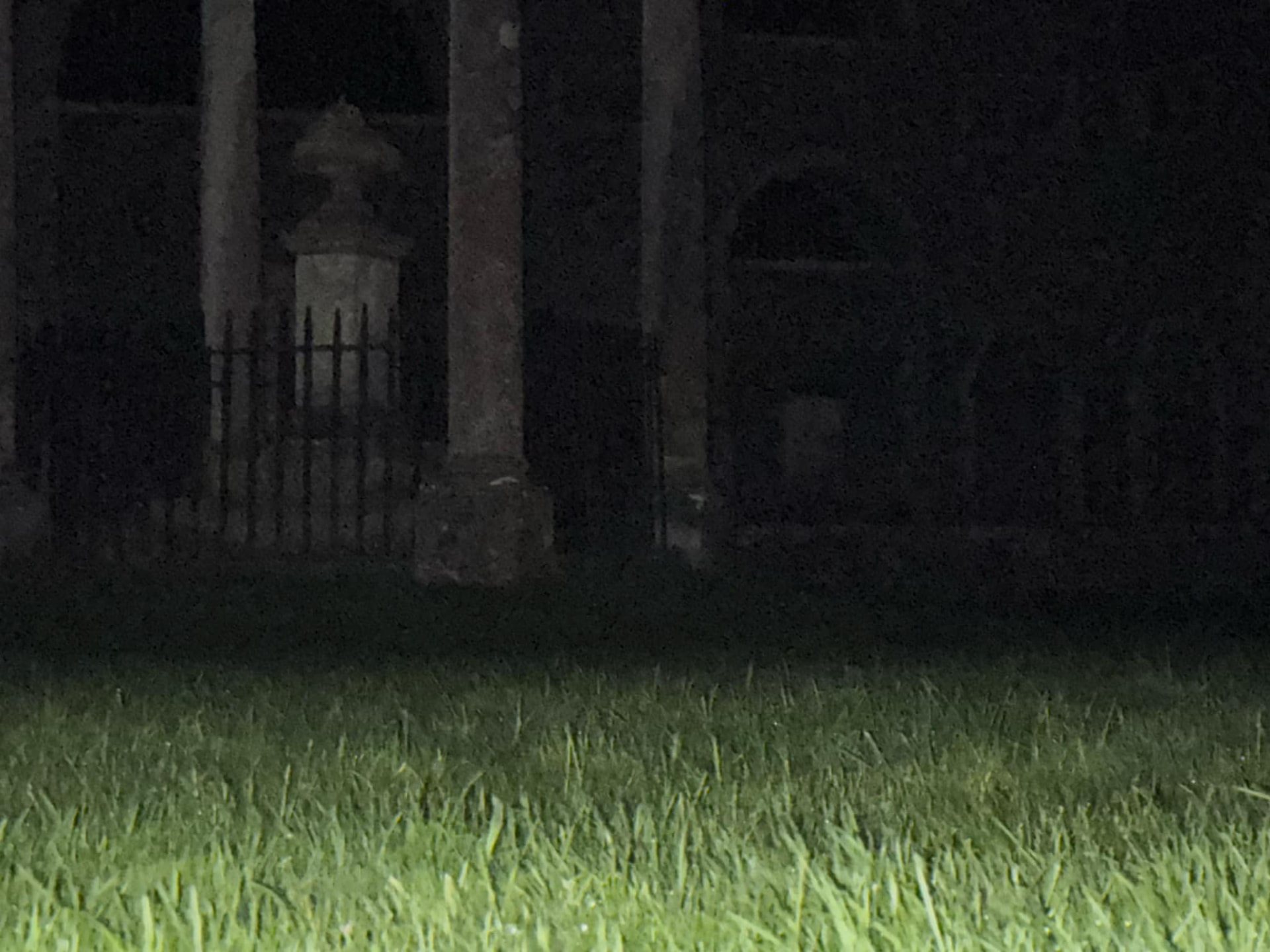
During a visit to the historic Dashwood Mausoleum at West Wycombe, an unusual formation was captured in a photograph taken by Time Travel Encounters.
The image shows the imposing structure of the mausoleum, its stone columns, iron railings and surrounding grounds.
However, looking towards the left-hand side of the monument reveals something that immediately attracts attention.
A strange, pale formation appears to be positioned behind the railings.
Its outline resembles a human head and upper body. The rounded shape at the top gives it an almost clown-like appearance, while the darker areas beneath seem to create the impression of facial features.
At first glance, it could be mistaken for a small figure standing beside the monument.
But what exactly has been captured?
Is it a stone ornament, an unusual shadow or an optical effect? Or is there something about this image that deserves further examination?
The History Of The Mausoleum
The Dashwood Mausoleum stands on West Wycombe Hill, overlooking the historic village of West Wycombe.
Built between 1763 and 1765, it was commissioned by Sir Francis Dashwood, one of the most colourful and controversial figures of eighteenth-century England.
The monument was designed as a memorial to the Dashwood family and their associates.
Its unusual hexagonal design, classical columns and open arches were inspired by Roman architecture.
Inside are memorial inscriptions, niches and urns commemorating members of the family and people associated with Sir Francis.
The structure is Grade I listed and remains one of Buckinghamshire's most distinctive historic monuments.
A Place With An Ancient History
The history of West Wycombe Hill stretches much further back than the construction of the mausoleum.
The monument stands on the site of an ancient hillfort, with archaeological evidence suggesting defensive activity dating back to the Iron Age.
For centuries, the surrounding landscape has been associated with human settlement, religious activity and remembrance.
The nearby Church of St Lawrence, the historic churchyard and the West Wycombe Caves all contribute to the unusual atmosphere of the location.
The mausoleum therefore stands within a landscape shaped by many generations of human activity.
Sir Francis Dashwood And His Notorious Club
Sir Francis Dashwood was a prominent politician and landowner who became associated with a notorious eighteenth-century gentlemen's club.
The club was remembered for its unconventional gatherings and controversial reputation.
The nearby West Wycombe Caves were excavated during the eighteenth century and became associated with the group's meetings.
Stories surrounding the club have contributed to the darker folklore of West Wycombe.
Although many of the more sensational stories have been exaggerated over time, the historical association is genuine.
It is an unusual setting for a mausoleum, and one that has attracted curiosity for generations.
The Story Of The Missing Heart
Perhaps the most unusual story connected with the mausoleum concerns Paul Whitehead, a poet and steward of Sir Francis Dashwood's notorious club.
When Whitehead died in 1774, his heart was preserved separately and placed inside an urn within the mausoleum.
The ceremony surrounding its placement was reportedly elaborate, involving music and military volleys.
The preserved heart later became something of a curiosity for visitors.
However, it eventually disappeared.
Historical and local accounts differ on the exact year of its theft, with references to both 1829 and 1839.
Its whereabouts remain unknown.
Over time, stories developed connecting Whitehead's spirit with West Wycombe and the surrounding area.
Whether these stories have any paranormal basis remains unproven, but the missing heart remains one of the most unusual episodes in the mausoleum's history.
The Photograph – The Figure Beside The Monument
The photograph examined by Time Travel Encounters shows a pale formation positioned to the left of the mausoleum's central monument.
The shape is visible behind the iron railings and appears to have a rounded upper section resembling a head.
Beneath this is a wider, darker formation, creating the impression of a face and upper body.
The overall appearance has an unusual resemblance to a human figure, with a somewhat clown-like outline.
The formation appears lighter than the surrounding darkness, making it stand out against the background.
Its position is particularly interesting because it appears to be separate from the main structure of the monument.
However, the photograph was taken in low-light conditions, and the image contains considerable grain and limited detail.
It is therefore difficult to establish the exact object or feature responsible for the appearance.
Possible Explanations
Several explanations must be considered.
The first possibility is that the formation is a stone urn, decorative feature or memorial ornament associated with the mausoleum.
The structure contains a number of architectural details and stone features that could create unusual silhouettes when viewed from a distance.
Another possibility is the interaction of shadows from the columns, railings and surrounding structures.
The low-light conditions may also have affected the photograph, with digital noise and image processing exaggerating the appearance of the formation.
Pareidolia is another possible explanation. The human brain naturally recognises faces and human shapes in ambiguous patterns, particularly when viewing images in darkness.
However, until the exact feature can be identified, the formation remains an interesting photographic anomaly.
Could It Be Something More?
The history of the mausoleum makes the photograph particularly intriguing.
This is a place specifically constructed to commemorate the dead.
Its walls contain memorials to members of the Dashwood family and their associates, while the story of Paul Whitehead's missing heart has become part of local folklore.
For paranormal investigators, such a location naturally raises questions about whether historic places can retain some form of unexplained activity.
Could the apparent figure be connected to someone remembered within the mausoleum?
Could it be related to the stories surrounding Paul Whitehead?
Or could the formation simply be an architectural feature that appears unusual when photographed at night?
There is currently no evidence to establish a connection between the image and any particular individual or reported spirit.
The TTE Conclusion
The Dashwood Mausoleum is a remarkable historic location, combining eighteenth-century architecture, family memorials, ancient landscape features and an extraordinary connection to the history of Sir Francis Dashwood's notorious club.
The story of Paul Whitehead's missing heart adds an unusual element to its past, while the surrounding landscape provides an atmospheric setting for paranormal investigation.
The photograph captured by Time Travel Encounters contains a particularly interesting formation beside the monument.
Its rounded, face-like outline gives the impression of a small human figure, with an appearance that some may interpret as clown-like.
We cannot currently establish whether this is an architectural feature, an optical effect or something that remains unexplained.
We are not presenting the photograph as definitive proof of paranormal activity.
However, it is an image worth retaining and examining further.
A daylight comparison photograph from exactly the same position would help establish whether the formation is part of the monument or an object behind the railings.
Until then, the figure remains unidentified.
And in a place built to remember the dead, perhaps it is understandable that a photograph like this leaves us with more questions than answers.
The living. The dead. The unexplained.
Some goodbyes are never the end.